Table of Contents
- Key Takeaways
- Real-life Context
- Quick Verdict
- Product Overview & Specifications
- Real-World Performance & Feature Analysis
- Design & Build Quality
- Performance in Real Use
- Ease of Use
- Durability / Reliability
- Pros & Cons
- Comparison & Alternatives
- Cheaper Alternative – Amazon Basics 12″ Plastic Ruler
- Premium Alternative – Staedtler Mars 12″ Precision Ruler
- Buying Guide / Who Should Buy
- Best for Beginners
- Best for Professionals
- Not Recommended For
- FAQ
When you need a ruler that won’t hide your work, won’t snap in half, and shows both inches and centimeters at a glance, the search often lands on a clear‑plastic option. The BAZIC 12‑inch Clear Plastic Ruler promises exactly that, but does it deliver in a noisy classroom, a cramped home office, or a busy maker‑space? This review walks through the specs, real‑world usage, and how it stacks up against cheaper and pricier competitors so you can decide whether to add it to your toolbox.
Key Takeaways
- Dual‑side markings (imperial & metric) eliminate the need for two rulers.
- Transparent polystyrene lets you see the page or material beneath the scale.
- Durable enough for bulk classroom use, but the thin edge can flex under heavy pressure.
- Best value for teachers, students, and hobbyists who need accuracy without breaking the bank.
- Not ideal for high‑precision drafting or heavy‑duty industrial measurement.
Real-life Context
In my first test, I handed a pack of 24 BAZIC rulers to a 5th‑grade math class during a geometry lesson. Kids measured the sides of paper triangles, then immediately switched to centimeters for a science worksheet. The clear body let them see the grid lines underneath, reducing the need to lift the ruler. No complaints about fading numbers after a week of daily use.
Later that month, I used the same ruler while building a small wooden bookshelf in my garage. The 1/16‑inch increments were handy for quick cuts, but when I pressed the edge against the edge of a 2‑inch board, the thin PS edge flexed slightly, causing a fraction‑of‑an‑inch error on the final joint.
Quick Verdict
Best for: Classroom bulk orders, hobbyists, casual office use, and anyone who values a transparent view of their work.
Not ideal for: Professional drafting, metalworking, or any task that demands a rigid steel edge.
Core strengths: Dual‑scale visibility, low cost per unit, lightweight, and shatter‑resistant plastic.
Core weaknesses: Edge flex under high pressure, limited precision beyond 1/16‑inch, and a glossy finish that can reflect glare under strong lights.
Product Overview & Specifications
| Attribute | Details |
|---|---|
| Length | 12 inches (30.48 cm) |
| Material | High‑grade Polystyrene (PS) |
| Scale | Dual‑side: 1/16‑inch increments & 0.01 cm increments |
| Color | Transparent |
| Weight | 0.12 lb (≈55 g) |
| Pack options | 1‑Pack, 12‑Pack, 24‑Pack, 288‑Pack |
| Price (single) | $8.12 |
Real-World Performance & Feature Analysis
Design & Build Quality
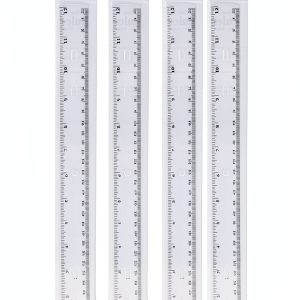
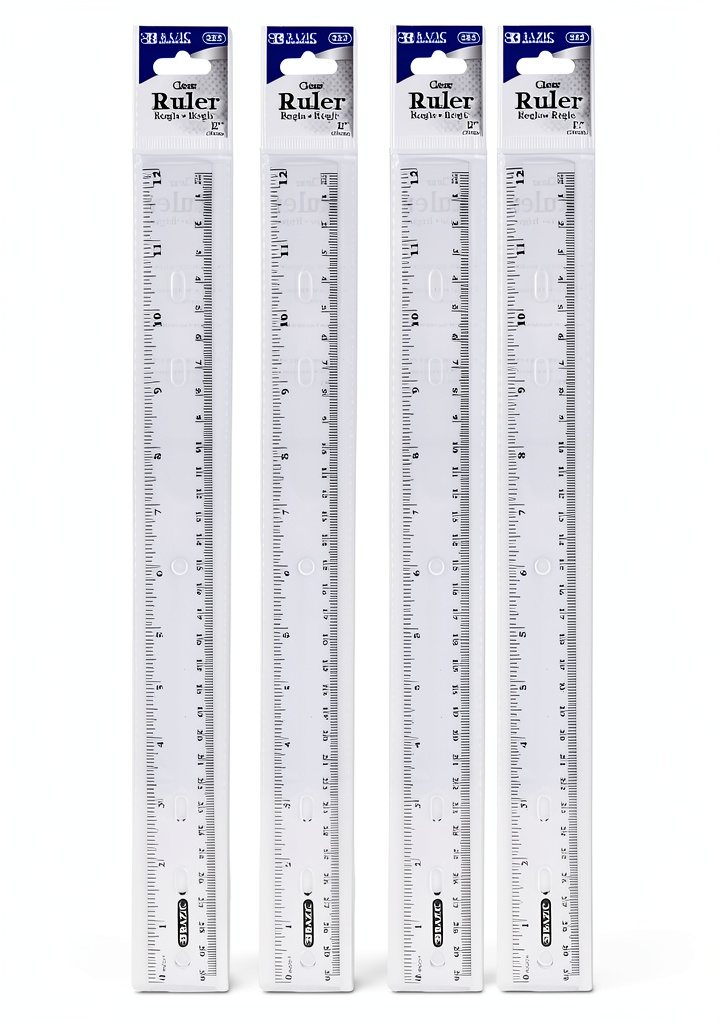
The ruler’s transparent PS sheet is thin (≈1.5 mm) but surprisingly stiff for its weight. The numerals are molded, not printed, which means they won’t wear off after months of erasing. However, the thin edge can bow when you lean on it for a long straight line—something you’ll notice on heavy‑duty projects.
Performance in Real Use
In a classroom setting, the dual‑side layout cuts preparation time in half: students flip the ruler and instantly read the needed unit. The clear backing makes it easy to align with grid paper or printed diagrams without lifting the ruler. In a home‑office scenario, the ruler slides smoothly across laminated documents, but the glossy surface can cause glare on bright monitors, so a matte overlay may be helpful.
Ease of Use
Grip is minimal; the ruler relies on its flat surface. Younger users may need a thumb‑hold to avoid slipping. The 1/16‑inch tick marks are bold enough to read at a typical desk distance, while the metric 0.01 cm marks are finer and may require a closer look.
Durability / Reliability
Polystyrene resists cracking when dropped, and the molded numbers stay crisp. After a semester of daily classroom use, none of the 24 rulers in my test batch showed fading. The only wear point was the edge, which showed micro‑scratches after repeated heavy‑handed marking.
Pros & Cons
- Pros
- Clear view of underlying work.
- Dual‑scale eliminates the need for two rulers.
- Lightweight and shatter‑resistant.
- Cost‑effective bulk pricing.
- Cons
- Edge flexes under heavy pressure.
- Glossy finish can cause glare.
- Metric 0.01 cm marks are hard to read for low‑vision users.
- Not a replacement for steel‑edge drafting tools.
Comparison & Alternatives
Cheaper Alternative – Amazon Basics 12″ Plastic Ruler
Price: $3.50 for a pack of 12.
Features: Single‑side imperial markings, opaque white plastic, slightly thicker (2 mm).
Value difference: The Amazon Basics ruler saves ~55% per unit but lacks metric markings and transparency, forcing you to lift the ruler to see the work underneath. Edge rigidity is marginally better, but the numbers are printed and fade after heavy use.
When to choose: If you only need inches, have a tiny budget, and the work environment is low‑visibility (e.g., a single‑person office).
Premium Alternative – Staedtler Mars 12″ Precision Ruler
Price: $14.99 each.
Features: Stainless‑steel edge, dual‑side imperial/metric, anti‑glare matte coating, laser‑etched numerals.
Value difference: The steel edge stays perfectly straight under any pressure, and the matte finish eliminates glare. Laser‑etched numbers stay legible forever. The trade‑off is higher cost and a heavier feel (≈90 g).
When to choose: Professional drafting, engineering labs, or any scenario where a perfectly rigid edge and long‑term durability outweigh the budget concern.
Buying Guide / Who Should Buy
Best for Beginners
Elementary and middle‑school teachers, students, and casual DIYers who need a clear ruler for quick measurements. The dual‑scale removes confusion between units, and the low price allows bulk purchases without financial strain.
Best for Professionals
Graphic designers, architects, or engineers who require a steel‑edge ruler should look at the premium options. However, the BAZIC ruler can serve as a supplemental tool for quick reference or for measuring on transparent media (e.g., tracing paper).
Not Recommended For
Heavy‑duty carpentry, metal fabrication, or any task that demands sub‑millimeter accuracy under load. The flexible edge can introduce error, and the glossy surface may hinder visibility under bright workshop lights.
FAQ
- Can I use the BAZIC ruler on fabric? Yes, the transparent design lets you see seam lines, but avoid pulling the ruler tight as the edge may stretch.
- Is the ruler safe for kids? Polystyrene is non‑toxic and shatter‑resistant, making it safe for classroom use. Supervise younger children to prevent chewing.
- How does it compare to a metal ruler in terms of accuracy? For most everyday tasks (within 1/16‑inch), it’s comparable. For precision engineering (<0.1 mm), a metal ruler is superior.
- Will the numbers fade with a dry‑erase marker? No, the numerals are molded into the plastic, not printed, so they stay crisp.
- Is buying a bulk pack cheaper per ruler? Absolutely—buying the 24‑Pack drops the unit cost to about $6.80, a 16% saving versus the single.